
I’ve worn the wrong foundation shade for years, and I know how frustrating that feels. You blend it in, step back, and your face looks either ashy gray or orange against your neck. The real problem is almost never the surface color you see in the mirror. It’s the undertone sitting underneath that decides whether skin undertone foundation matching actually works for you.
After testing more than 30 shades on myself, friends, and beauty clients over the past three years, I’ve learned that finding your true undertone is less about rules and more about reading your own features. In this guide, I’ll show you the exact methods I use, why some popular tests fail for certain skin types, and how to pick a foundation shade that disappears into your skin in 2026.
What Are Skin Undertones and Why Do They Matter?
A skin undertone is the underlying color beneath your skin’s surface that stays consistent no matter how tan, pale, or flushed you get. It comes from the natural pigment in your skin, plus the color of the blood vessels and tissue underneath. Your undertone does not change with the seasons or with sun exposure.
The surface color, also called skin tone, is the depth of color you actually see in the mirror. Fair, light, medium, tan, deep, and ebony are all surface tones. Two people with the same surface tone can have completely different undertones. That’s why a friend with the same fairness level as you might look glowing in a foundation that makes you look sickly.
Knowing your undertone matters because it decides whether foundation, concealer, blush, and lip color look like skin or look like paint. If the undertone is off, the foundation will read ashy (too cool), orange (too warm), or muddy (too neutral) as soon as it hits your skin.
I learned this the hard way after buying a “porcelain” shade online that looked perfect in the bottle and ghostly gray on my jawline. The surface tone was right. The undertone was completely wrong.
The Three Main Undertone Types (and a Fourth You Should Know)
Most undertone systems describe three categories: cool, warm, and neutral. But after working with hundreds of faces, I can tell you olive is a real fourth category that gets ignored far too often. Here’s how each one reads on skin.
Cool Undertones
Cool undertones have a pink, red, or bluish base. Veins on the inner wrist often look blue or purple. Skin tends to burn easily in the sun and may flush pink rather than tan gold. Foundations with blue or pink bases tend to disappear into cool skin, while yellow-based formulas can look jaundiced.
Warm Undertones
Warm undertones have a yellow, golden, or peachy base. Veins may appear greenish. Skin usually tans easily and bronzes rather than burns. Foundations with yellow or golden bases blend in beautifully. Pink-based formulas can make warm skin look chalky or flat.
Neutral Undertones
Neutral undertones sit between cool and warm. Veins may look blue-green or you genuinely can’t tell. Foundations labeled neutral usually work without pulling too pink or too yellow. Many people with neutral undertones lean slightly one way, so knowing whether you are neutral-cool or neutral-warm helps refine the choice.
Olive Undertones
Olive skin has a greenish or grayish cast underneath warm yellow pigment. Veins often look green even when the surface color is light. This is the undertone that breaks the standard cool/warm/neutral rules. People with olive undertones often get matched as warm but then find their face looks orange, or matched as cool and look ashy. A touch of green in the formula, sometimes called a golden olive or neutral olive, tends to work best.
How to Find Your True Skin Undertone at Home?
Below are the six tests I walk through with every client. None of them work perfectly on their own, but combined they give a clear answer. Take your time with each one and avoid fluorescent bathroom lighting. Natural daylight near a window is the gold standard.
The Vein Test
Look at the veins on the inside of your wrist in natural light. If they look blue or purple, your undertone is likely cool. If they look green, your undertone is likely warm. If you see a mix of both or can’t tell the color, you probably sit in the neutral or olive range.
This test can fail for very pale skin (where veins always read blue) and very deep skin (where veins may not be visible). Treat it as one data point, not a verdict.
The White Paper Test
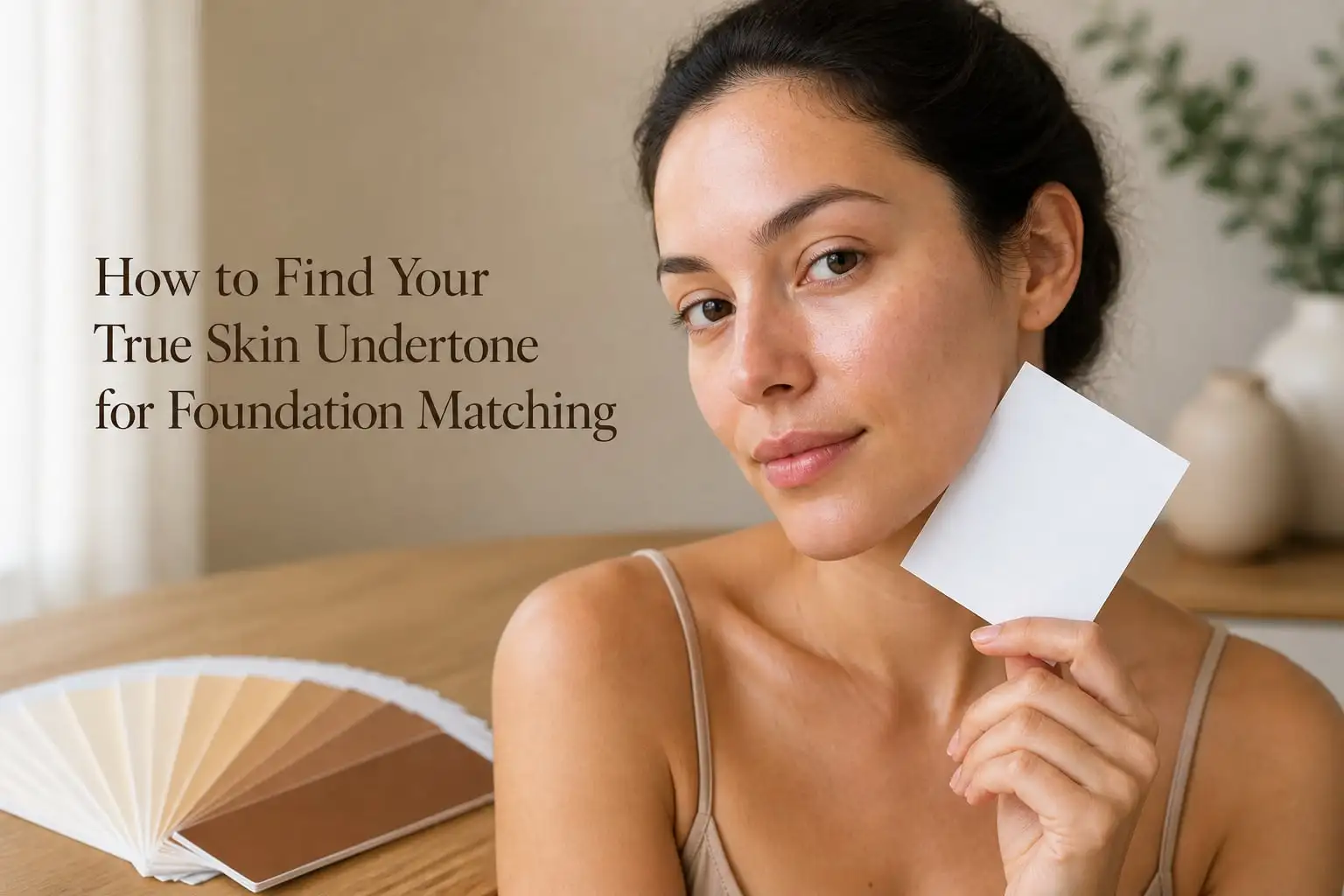
Hold a plain white piece of printer paper next to your bare face. Stand near a window and look in the mirror. If your skin looks pink or bluish against the paper, you lean cool. If your skin looks yellow or golden, you lean warm. If your skin looks grayish-green, you may have olive undertones. If nothing obvious jumps out, you are likely neutral.
Skip this test under artificial light. Overhead LEDs and warm bulbs will completely distort the comparison.
The Jewelry Test
Try on both silver and gold jewelry side by side and look at your skin in natural light. If silver makes your skin look bright and clear while gold looks brassy, you lean cool. If gold makes your skin glow and silver looks dull, you lean warm. If both look fine on you, you are likely neutral.
Wearing one metal more often than the other is a subconscious preference that often lines up with undertone. I noticed my own drawer was 80% silver long before I tested my veins.
The Behind the Ear Test
Gently pull your ear forward and look at the skin behind it where the sun rarely hits. This patch is one of the most accurate spots because it has the least surface influence from sun, redness, or skincare products. The color you see here is closest to your true undertone. Match the foundation to this area, not your cheek.
The Sun Reaction Test
Think back to how your skin behaves in the sun, not how it tans now, but how it reacted the first times. Burning easily and turning pink before any color appears leans cool. Burning first then gradually tanning leans neutral. Tanning quickly and easily with rare burning leans warm. Deep skin tones may not produce a clear signal here, which is fine. Skip this one and lean on the others.
AI Foundation Finder Tools
Apps and tools like the Perfect Corp Shade Finder, Sephora’s Color IQ, or chat-based assistants can speed up the process. They analyze a photo in consistent lighting and cross-reference shades across brands. They work best when you submit a photo taken in neutral daylight with bare skin and no makeup.
Treat AI tools as a starting point, not a final answer. They struggle with very deep skin, very pale skin, and olive undertones. I’ve seen AI suggest a perfect match only for the user to find the formula oxidizes orange by 3pm. Use the tool, then swatch in person before committing.
How to Match Foundation to Your Undertone?
Once you know your undertone, the foundation matching process becomes a checklist. These are the steps that have saved me the most money and time over the years.
Swatch on Your Jawline, Not Your Hand
The back of your hand has different undertone and texture than your face. Always swatch along the jawline, blending three shades close to your undertone, then step outside into daylight. The right shade disappears into your skin. The wrong shade draws a visible line, looks orange, or looks gray.
Check Your Foundation in Two Light Sources
Test the shade in natural daylight and in the lighting where you spend most of your day, whether that’s office fluorescents, warm restaurant lights, or evening lighting. If the match survives both, you have a reliable everyday shade. If it shifts drastically, you may need to go one shade lighter or darker for that environment.
Account for Oxidation
Many foundations oxidize, meaning they darken or shift warmer within 30 minutes to 2 hours of application. This is one of the most common frustrations in foundation matching. To counter it, swatch and wait. Step outside 30 minutes after applying. If the shade now reads too dark or too orange, go one shade lighter or choose a formula labeled non-oxidizing.
Match Your Neck and Chest, Not Just Your Face
Your face is often slightly darker than your neck and chest due to daily UV exposure and product buildup. Half a shade deeper than your natural neck color is the sweet spot for most people, so the foundation blends seamlessly from face to neck without a visible line.
Coordinate the Rest of Your Makeup
Once foundation matches, blush, bronzer, lipstick, and even clothing colors look better when they share your undertone family. Cool undertones glow in berry, mauve, and pink lipsticks. Warm undertones come alive in coral, peach, and brick. Olive undertones can usually wear both as long as the base has enough of that neutral green balance.
Frequently Asked Questions
How can I determine my skin tone to match my foundation?
Determine your skin tone by looking at the surface depth of color in natural light, categorized as fair, light, medium, tan, deep, or ebony. Then find your undertone using the vein test, white paper test, jewelry test, and the behind the ear test. Match a foundation that matches both your surface depth and your undertone family for the most natural result.
How do I find my true match foundation shade?
Swatch three close shades along your jawline in natural daylight and choose the one that disappears into your skin without leaving a visible line. Then wait 30 minutes to check for oxidation, since many formulas darken or shift warmer over time. The shade that blends seamlessly into both your face and neck is your true match.
Can ChatGPT find my foundation shade?
ChatGPT can offer guidance based on your described skin concerns, but it cannot see your skin in person. For accurate matching, combine AI suggestions with a physical swatch test in daylight using the vein, white paper, and jewelry tests described above.
Is there a foundation that matches all skin tones?
No single formula matches every skin tone perfectly, because surface depth and undertone vary widely across people. The closest options are shade-adjusting primers or custom-blend services that mix two or three shades to match your specific combination of depth and undertone.
Why does my foundation look gray or ashy?
A foundation looks gray or ashy on skin when its undertone is cooler or more pink than your natural undertone. Switch to a formula with more yellow or golden pigment if you have warm or olive undertones, or warm-neutral blends for neutral skin.
Final Thoughts on Your True Skin Undertone
Finding your true skin undertone is the difference between foundation that looks like skin and foundation that looks like makeup. Use the vein test, white paper test, jewelry test, and behind the ear test together in natural daylight to spot your undertone family. Then swatch along your jawline, wait 30 minutes for oxidation, and confirm the match in the lighting where you actually live your life.
If you have struggled with ashy, orange, or plain wrong-looking foundation in 2026, start over with these tests today. Your undertone has been there the whole time, quietly shaping every color choice. Now you have the tools to read it correctly.